# Peter XIV and KiRi-Kama
[[Hall of Mirrors/The Bestiary|The Bestiary]] · the second bestiary page
> **One-line reading.** The first bestiary gives each station of the Tree an animal. This second page gives the animals a world: a clan with a leader, a teacher who is also a barber, a temple gate and a stair, a seed falling toward mountains, and a small city. Read as this guide reads it, the page asks how a cosmos becomes somewhere people live.
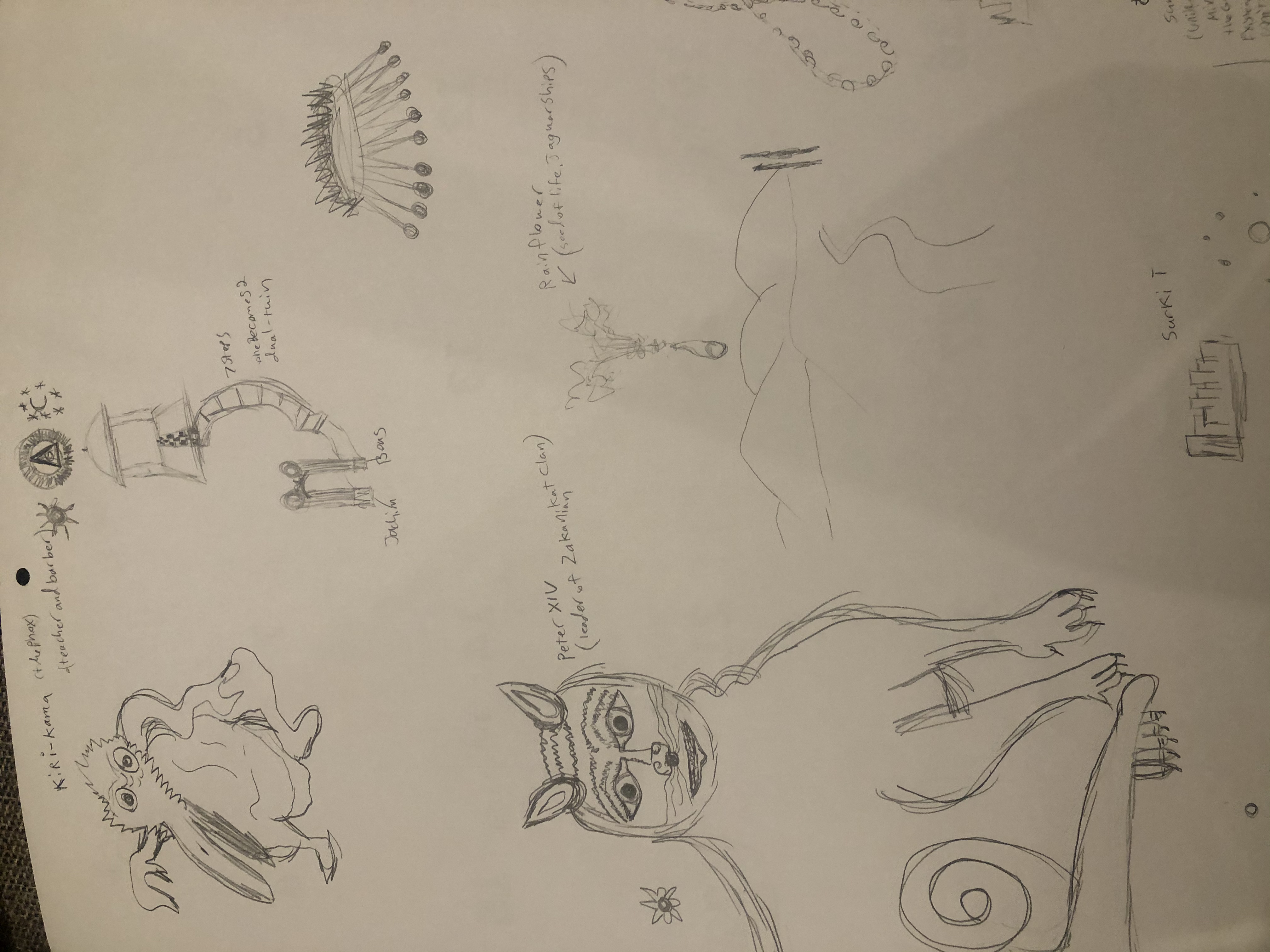
*A pencil sheet from the Hall of Mirrors. Top left: a shaggy, big-eyed creature captioned "KiRi-Kama (the Phox) (teacher and barber)". Top centre: small sun, circle-and-triangle and crescent-with-stars signs over a domed gate with a checkered stripe, reached by a curved stair annotated "7 steps" and "one Becomes 2 / dual-twin", between pillars labelled "Jachim" and "Boas". Right: a spiky lens- or crown-shaped object with ten ball-tipped stalks hanging below it. Lower left: a large cat-eared figure with a human face, long hair and a spiral on its haunch, captioned "Peter XIV (leader of Zakanlian Kat Clan)". Centre: "Rainflower (seed of life, Jaguarships)", a flower with a falling pod above mountains and a winding road. Bottom: a small settlement labelled "Surki T".*
> [!infobox] The second bestiary
>
> - **Room:** *Roy "Peter XIV" Sketch*, opened by the code `SELF DOUBT` (the first negative trait of stage 5 on the "I'm 33" board)
> - **Shelf:** *Unseen*, like the ten portraits
> - **Figures:** Peter XIV, leader of a Kat Clan · KiRi-Kama, the Phox, teacher and barber
> - **Architecture:** the pillars Jachim and Boas (Jachin and Boaz), a stair of seven steps, a gate
> - **Written on the sheet:** *one Becomes 2* · *dual-twin* · *Rainflower (seed of life, Jaguarships)*
> - **Facing page:** a planetary map (room 87), the other half of the same notebook opening
## A world beside a map
The two pages were photographed as one notebook opening. The right edge of this sheet catches the first letters of the facing page. That facing page is a **planetary map** drawn in columns, from a *Sun world* through Mercury, Venus, Earth and Mars out to Neptune, with notes under each: *Mirror*, *the Great Jagwar*, *Existed Forever*, *Unity* under the Sun world, *7 sisters* under Saturn, and a city at almost every station.
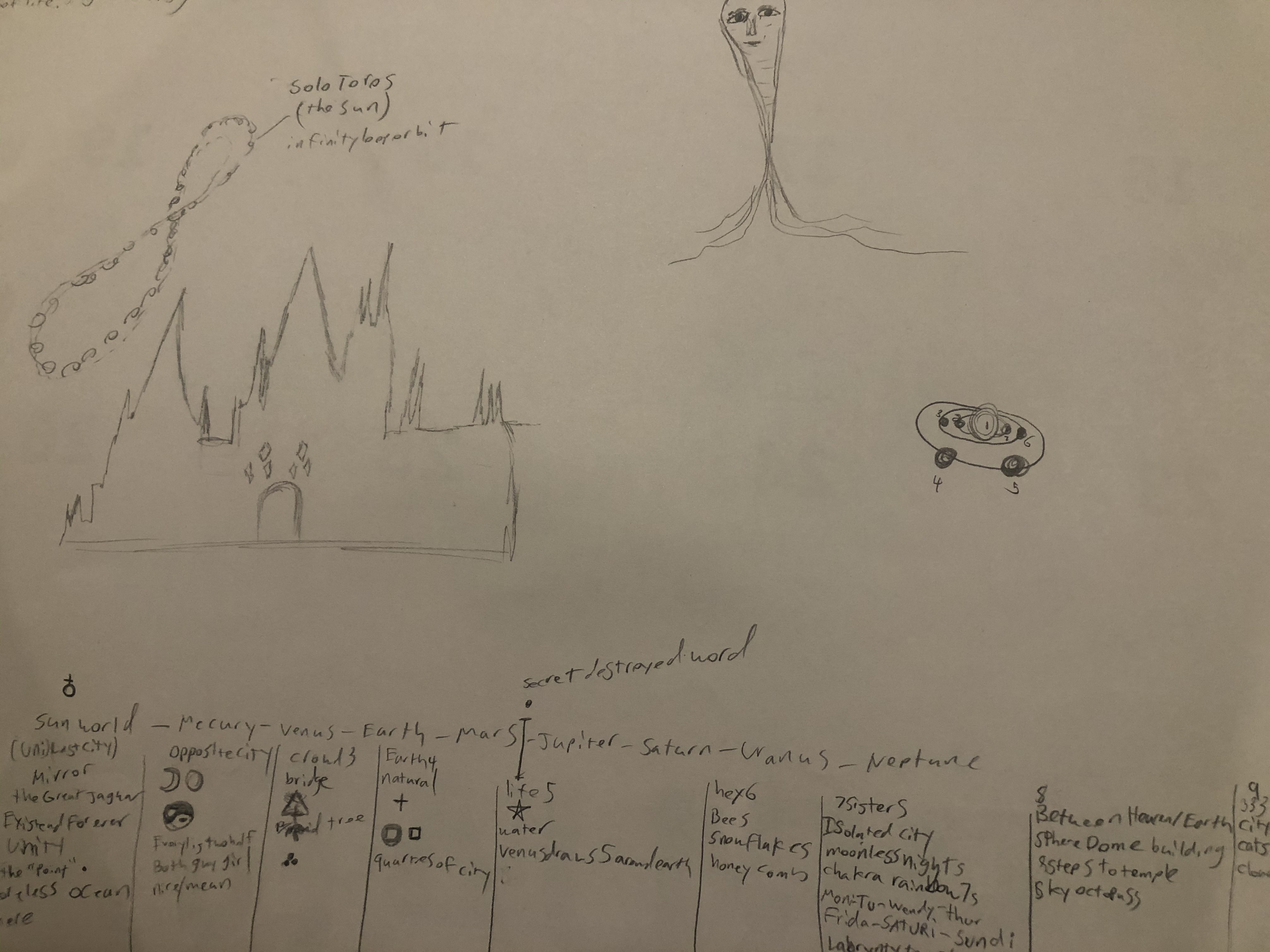
*The facing page. A chain of links labelled "Solo Toros (the Sun) infinity bar orbit" loops over a spired city. Below, a row of columns runs from "Sun world" through the planets to Neptune, each with its own notes.*
Put side by side, the division of labour is clear. The map gives the order of a cosmos, station by station. This page shows what it might look like to live inside that order, with a people, a trade, a temple and a town. The first bestiary made each animal an office on the Tree. This page makes offices into lives. It is this guide's reading of how the two pages work together; the pages themselves only sit side by side.
## Peter XIV
Peter is drawn large: cat ears, whiskers and a cat's nose on a masked, human face, with long hair falling on both sides, a spiral on the haunch and clawed paws. His caption makes him a **leader**, *of Zakanlian Kat Clan* (the middle letters of the clan word are hard to read). In the photograph a single tail-like band runs under the hind paw and off the edge of the frame. A fuller description of the sheet gives Peter three tails, which the available image can't confirm.
The *XIV* reads first as a regnal number, like a king's: Peter the Fourteenth. That small detail changes what kind of figure he is. **A number after a name means an office that outlasts the person holding it.** Peter isn't just a character. He is the current bearer of a line, the one through whom a people's continuity passes. Beside [[The Circle]], where the Jagwars' song is denied by kings and caged by empires, a leader of a cat people carries both possibilities: an office can keep a people's memory alive, or it can keep an enclosing order going.
The name adds a quieter layer. *Peter* means **rock**: in Christian tradition, the rock on which a community is built, the keeper of the keys, and the first in a line of succession. On a sheet full of gates, pillars and a stair, that resonance is hard to miss, but it is a resonance, not a statement on the page.
Two further lenses are available and are held lightly:
- **Tarot XIV** is Temperance: a figure pouring between two vessels, mixing what was divided. In the Golden Dawn system it is the path that joins the Moon to the Sun. On a page that writes *one Becomes 2* and *dual-twin*, it offers an image of the work Peter's office might demand: holding different parts of a world in relation without making them the same.
- **The nekomata** of Japanese folklore is an old cat whose tail divides as it gains new powers, including humanlike ways. It is a useful comparison for a humanlike cat. It is not a source.
## KiRi-Kama, the Phox
KiRi-Kama is shaggy and big-eyed, with a spiky crest. A long, hatched form projects from the face, read as a beak. Where a wing or hand should be there is a two-pronged pincer. The caption gives a spelling and two jobs: ***the Phox***, and ***teacher and barber***.
The strongest comparison is the **kamikiri**, the hair-cutter of Japanese folklore, a creature with a beak and scissor-like hands that snips people's hair. A barber with pincers fits it closely. One detail from a historical yokai scroll gives the comparison real reach. In one scroll's account, the kamikiri appears to cut the silk of a giant spider. A cut, in other words, can free something from a web. The Bestiary's own spider sits at the Sun, and in *Online* the internet is a web whose spider feeds on its users. So there are two kinds of web in this work, one that connects and one that catches. A barber who can cut silk is a figure for telling them apart.
That is where *teacher* matters. A barber removes and reshapes growth; a teacher gives someone distinctions they can use. Joined in one being, the two jobs make **cutting a form of clarity**. The darker reading stays open too: cutting someone's hair against their will takes away their look and their control, and a teacher who decides what you should become can do the same. The figure asks what a cut leaves the other person able to do. Beside *The Circle*, the lesson is sharp: **cutting away a lie is not cutting away a protection.** In the song, the maker hides it in the Jagwars' wings right after the kings deny it, which reads as putting it there to keep it safe.
The name may play with its source. The Japanese word for the praying mantis, a creature with cutting forelegs, is *kamakiri*: *kama* (sickle) plus *kiri* (cut). *KiRi-Kama* reverses those two parts. That is a question worth holding, not an established etymology. The *Phox* spelling also sits beside the ladder's own Fox, Michael the scientist, whose work is to distinguish and build. A pelican, the bird said to feed its young from its own breast, is a further comparison some readers see in the long beak.
## The page's larger action
The page writes its own central movement in plain words: ***one Becomes 2***, ***dual-twin***. The paired pillars, *Jachim* on the left and *Boas* on the right, give that division an architecture. These are Jachin and Boaz, the two pillars at the door of Solomon's Temple, in the same J-left, B-right order as the pillars in *[[Hall of Mirrors/The Bestiary - The Vulture|The Empty Room]]*. A stair of seven steps climbs from them to a gate marked with a checkered stripe. The annotation has also been read as *7 stars*, and the glyphs allow both.
**Rainflower** hangs above the mountains, labelled *seed of life* and *Jaguarships*: a flower head with a pod dropping from it, toward a winding road and a small city. Read as this guide reads it, that is life arriving at a place where it can take a particular form. A *Jaguarship* is a vessel carrying the seed. *Rainflower* also sounds like a child's name for the iris, whose name means both the rainbow and the flower. That is a pleasing echo, not a claim.
Above the gate sit a small sun, a radiant circle holding a triangle, and a crescent ringed by exactly seven stars. The facing map's *7 sisters* makes the Pleiades the likeliest seven. To the right, ten ball-tipped stalks hang from a spiky oval. It can be read as an upside-down crown pouring down into the world, or as a lens the world is seen through. The count of ten is not in doubt. Two heavy unlabelled strokes stand by the mountains: poles, or a pair of very minimal watchers.
## Where it connects
- **[[Hall of Mirrors/The Bestiary|The Bestiary]]**: the first page gives each station of the Tree an animal; this one gives them a society.
- **[[Hall of Mirrors/The Bestiary - 6 The Spider (RAPhael)|The Spider]]**: the barber who can cut a spider's silk sits beside the ladder's solar spider and the web of *Online*.
- **[[Hall of Mirrors/The Bestiary - 8 The Fox (Michael)|The Fox]]**: *the Phox* and *Michael the Fox* are two ways of making distinctions, the scientist's and the barber's.
- **[[The Circle]]**: a people, their song, the powers that deny and cage it, and a cut that must not remove the protection.
- **[[Hall of Mirrors/The Bestiary - The Vulture|The unnumbered Vulture]]**: the same J-and-B pillars stand at *The Empty Room*.
- **[[Another Way II Heaven]]**: the song's first move is one becoming two, which this sheet writes out as *one Becomes 2*.
## Open questions
- **How many tails?** The fuller description says three; the photograph shows one band leaving the frame.
- **7 steps or 7 stars?** The glyphs allow both.
- **Is Peter the ladder's foundation?** The first bestiary opens with Enoch, a man raised to the crown. Peter's name means the rock that is laid as a foundation. Whether the two men are meant as a pair, one at each end of the Tree, is an open question.
- **Where does the name KiRi-Kama come from?** Is it a reversal of *kamakiri*, or something else?
---
[[Hall of Mirrors/The Bestiary|← All the animals]] · [[Hall of Mirrors/The Bestiary - The Equations|The Equations]]