# Sir Lucius
> **One-line reading.** Sir Lucius is the mind severed from the heart: a protective intelligence that pulled Roy out of the dark, then risked becoming the thing that keeps him there. He only ever tells the truth, but the truth can be deceiving.
<img src="https://plumcreekranch.com/jagwar/lucius_left.png" alt="hom-lucius-float-card-main">
*The regalia: white face paint, the horned rabbit headpiece, the red coat, the cigarette, the green apple. A clown, a courtier, a warning label.*
> [!infobox] Sir Lucius
>
> - **Also known as** — the final boss · the mastermind · the Light-Bearer
> - **Nature** — the mind severed from the heart
> - **Register** — mercurial · theatrical · reflective · audience-dependent
> - **First resonance** — 2009 (Eye Alaska)
> - **First clear appearance** — *Good Time (1:08)*, 2023 *(per Roy)*
> - **Public arrival** — co-credited on *Not Your Homie*, Oct 31 2025; full album billing on *Lucius Lullaby*, March 27 2026
> - **Mark** — 🍏 / 🗡🍏
> - **Marking** — *El Roi* (throat; character makeup, not ink on Roy)
> - **Symbols** — [[The Green Apple]] · [[The Crow|crow / Corvus]] · cigarettes · *El Roi* · [[The Mirror]] · [[The Mask]] · [[The Rabbit]] · trumpet / bugle · dagger
> - **Counter-pole** — [[Roy]]: heart · sword · dove / Cygnus · *El Roy*
> - **Esoteric lens** — Hod / Mercury (intellect, speech, cleverness, analysis)
> - **Related** — [[Roy]] · [[Mary]] · [[Sir Rabbit]] · [[The Attention Economy and the Circus|BMRC / Leif]] · [[The Green Apple]] · [[The Light-Bearer]] · [[The Speaker Problem]]
---
## Start here
Sir Lucius is Roy's shadow: the mind severed from the heart. He is not an outside villain, and this is the first thing to unlearn, because the costume works so hard to sell you the opposite. **Lucius is not darkness in opposition to light. That's a false narrative, misdirection, trickery.** He is a part of Roy's own interior life, the protective intelligence that pulled him out of the dark and then risked becoming the very thing that keeps him there.<img src="https://plumcreekranch.com/jagwar/shadow.gif" style="float: right; width: 155px; margin-left: 16px; margin-bottom: 8px;">
That word, *shadow*, is doing technical work, so let me be plain about it: he is Roy's shadow in the Jungian sense, *"the mind divorced from the heart."* The shadow is not simply "the bad part." It is the rejected part, the buried part, the part of the self pushed out of sight because it felt dangerous, shameful, unacceptable, or just too much to carry. Sometimes it is ugly. Sometimes it is powerful. Usually it is both, because apparently being human was not complicated enough already. And the shadow rarely arrives looking like a bunny-clown. It usually shows up disguised as a reasonable explanation for what just happened, and it brings receipts.
Characters in the Jagwar Twin cosmos defy clean labels and mappings, but the simple version is this: Lucius is Roy's sharp mind when it stops serving the heart and starts running the house. Roy has said it about as plainly as it can be said, the mind is a tool, but a tool that *"can lead us astray if it is not subservient to the heart."* Lucius is what the tool becomes when it stops serving and starts ruling: the fast voice, the survival system, the part that knows exactly where the wound is because it has been guarding it for years.
Here is the cleanest one-sentence version of him I have, and it doubles as a warning about how sincere he is: **Lucius is a Gurdjieffian self-diagnosis turned into public art, I am the false personality I'm warning you about, watch me try to see it.** That is the whole audacious move. The artist personifies one pole of himself, hands it a microphone and an artist page, and lets it sing the diagnosis of its own disease. Which is exactly why he is so easy to mishear as the plain villain. He is not the plain villain. He is *us*, dressed up. We made him, he is us, but we don't recognize him; things kept chained in darkness can become twisted and changed.
This is what makes him dangerous, and it has nothing to do with lying. He is not stupid. He is not random chaos. He is not even simply wrong. **He tells the truth.** That is the problem. The single fact to hold about his method: he does not lie, he is a master of the *angle*. He selects, frames, and emphasizes true things. Roy holds a hard floor that Lucius quietly drops, *"the truth is a spectrum, but a lie is a lie."* Lucius's whole exploit is to live in that spectrum, to deceive without ever technically lying. The trick is not lying. The trick is angle.
The concepts he carries all rhyme with that. **The green apple 🍏** is his cleanest mark: knowledge taken before it is earned, intelligence divorced from spirit, power before maturity, fruit that is not ripe. He is the ingester of green fruit, power accessed before spiritual maturity, self-sabotage disguised as strategy and logic. **The crow** (its constellation, Corvus) is the clever mind that knows how to use that unripe knowledge, comfortable around ruin. **The cigarette** is counterfeit breath, harm made to look elegant. And on his throat sits *El Roi*, Hebrew for *"the God who sees me,"* a creature made almost entirely of reflection wearing the name of the divine seer, worn at the exact gate where thought becomes sound. Hold the whole stack of him at once and do not flatten it: **he is the guide and the trickster. He is the God Who Sees Me if we are to believe him, but he is a twisting of knowledge. He is ancestral trauma, and personal shadow. He is also Roy, and what came before Roy.** He is the very human shadow, the echo left behind by the failed attempts to reunite with the divine spark, our collective baggage. Possibly the most human thing there is.
His first job was protection, and this is where the tragedy lives, so I am not going to undercut it. The vulnerable thing he guards is the buried [[Brandon|Ballerina Boy]], the shamed child who learned that being visible and vulnerable could be dangerous. Lucius does not hide the boy because he hates him. He hides him because he believes exposure will kill him. That is the whole trap: the guard became the prison, and the strategy that kept the wound from being touched also kept it from healing. So the drama has three voices, not two. Lucius says *stay hidden, don't be vulnerable.* [[Mary]] says *you were born to shine.* And Roy has to become <img src="https://plumcreekranch.com/jagwar/trio.png" style="float: right; width: 120px; margin-left: 16px; margin-bottom: 8px;">strong enough to believe Mary and confront the shadow, understanding it and making it serve the heart. That last clause is the whole ethic of the arc. The resolution is never *destroy the protector.* The resolution is right order: *my mind must serve my heart.* You tame the beast, you do not destroy it.
And there is a participatory joy in this that the analysis should not flatten, because part of what the figure is *for* is letting the buried thing out on purpose. Take fear, failure, insecurity, name them Lucius, give them bunny ears and let them party out in the light where you can finally see them. As you sing along as Lucius you are literally embracing your inner shadow instead of trying to repress it all the time. It's a safe place to let it out and get it good and tired. And it is exactly why I stop scrolling when a bunny-clown tells me he is juggling my darkest thoughts. *Say more, friend.*
That is the whole page in miniature. Everything below is optional depth. None of it is the answer, it is just one way of seeing it, and if I ever sound sure I am doing it wrong.
## Where he sits
Everything about Lucius gets clearer the moment you stop reading him alone.
Start with the axis, because there is only one. **Lucius** gathers one end of it: intellect, reflection, appetite, smoke, cleverness, unripe knowledge. The green apple, the crow, the cigarette, the mask, the mirror. The mind that stopped serving and started ruling. **[[Roy]]** holds the other end: heart, choice, vulnerability, discernment. The heart, the sword, the dove / Cygnus. The heart trying to recover agency without losing its edge. Two ends, one line, one person. And the border between them is not a cliff but a slope: Roy doesn't *fall* into Lucius, he *slides* toward him. There is no point of no return, because Lucius is simply a different frequency of Roy. In Hermeticism you don't kill the dark pole, you polarize yourself toward the light while acknowledging the dark is the same string. (The Tree-of-Life version, mind serving heart, lives on [[Kabbalah - The Tree of Life]]; the two-brothers version on [[Jacob and Esau]].)
Which is exactly what makes **[[Mary]]** interesting. She is not on the line. She gathers the signs of generative light, not "nice" light but creative authority, the call that brings the buried self back into visibility. She does not pull against Lucius from the far end of his axis; she stands off it entirely, and that is why she is the one frequency he cannot absorb. Two poles make an argument. A third point makes a triangle, and a triangle is the first shape that can hold something. (Mary, the Wise One, and SARAVI are archetypal neighbors here, not one person; keep them distinct.)
Do not treat that as a rigid codebook. Characters here do not stay politely inside one box. But the pattern is strong enough to start with:
Lucius has the apple. Roy has the sword. Mary has the song. Now the argument begins.
## Meet him here
If you are new and want to *see* him rather than read about him:
- **[[Welcome to the Circus]]** — Lucius at full external power, the "final boss."
- **[[The Interview]]** — the bargain staged as comedy, Roy and Lucius across a table fighting over the music.
- **[[Lucius Lullaby (album)|Lucius Lullaby]]** — the 2026 album that hands him the microphone and lets him take over the rollout.
- **[[The Green Apple]]** — his mark, decoded, if you want the single clearest symbol first.
## How this page works
The core is above. Everything below is optional depth, folded into collapsible drawers so you can open only what you want. It is ordered the way this guide reads anything: grounded material first (direct quotes, released music, public posts and videos), then the strong interpretive readings, then the esoteric framework held loosely, then the most speculative material clearly marked and tucked at the very bottom. Open a drawer to go deeper. Ignore all of them and the core still stands on its own.
---
> [!note]- Just the Truth, baby!
> This is Roy's own definition, and it is the cleanest key to the figure. The mind, in his framing, is a tool, but a tool that *"can lead us astray if it is not subservient to the heart."* Lucius is what the mind becomes when it stops serving and starts ruling.
>
> The fullest description Roy has given runs roughly like this: with Lucius, *"anything is possible."* There is a supreme confidence about him, and he is fast, and he does not care what anyone thinks. What is frightening is that *even though he only tells the truth,* at least from his own perspective, that truth *"can drag you to hell,"* because it is *"only the perspective of the mind."* He can tell you that you are a failure, or that they do not really love you, and logically point to every reason why, and if you believe him, *"the you that is truly YOU dies."*
>
> That is the engine under everything he does. **He is not a liar. He is a teller of true things, deployed to cut,** by selection, framing, and emphasis, never quite by lying. There is an ethic buried in the contrast: Roy holds that *"the truth is a spectrum, but a lie is a lie."* Truth can be shaded and bent, but there is a hard floor. Lucius's whole exploit is to weaponize the spectrum, deceiving without ever technically lying, while quietly dropping the floor Roy keeps. He even announced the method himself, on his takeover of the Instagram account: *"while Sir Lucius only tells the truth, the truth can be deceiving 🍏."*
>
> The trick is not lying. The trick is angle.
>
> And crucially, you do not *beat* him. Roy is explicit that the work is polarity and integration, not conquest: *"what we fight, we become, and we become what we fight,"* and *"these thoughts are not my own."* The move is not to defeat Lucius. It is to see his shadow and then say *these thoughts are not my own,* to stop mistaking his voice for your own. And keep one small brake within reach, because it disarms half of what he does: certainty is just a tone, not a truth. Lucius has perfect pitch in that tone.
> [!props]- Trinkets and Accessories
> Start with the props, not with demonology. The figure is legible through what keeps clustering around him.
>
> **The green apple 🍏.** His cleanest object-symbol: knowledge taken before it has been earned, intelligence divorced from spirit, power before maturity, fruit that is not ripe. <img src="https://plumcreekranch.com/jagwar/lucius_apple.png" style="float: right; width: 120px; margin-left: 16px; margin-bottom: 8px;">Genesis 3 without cracking The Book, the brilliant shortcut that promises sight before integration. The channel-authored LOOP teaser copy decoded it in his own third person: *"the green apple plucked too soon, self-betrayal dressed as logic, self-sabotage disguised as strategy."* His full signature, 🗡🍏, sharpens it: the apple is the knowledge, the dagger is how he uses it. (Roy also points to Paul Foster Case's Devil card, where a green apple blocks the figure's right, solar eye while the left, receptive eye stays open on the viewer. The apple is not a prop, it is a position.) And the position explains the fruit: **seeing clearly from the wrong position produces a kind of knowledge that cannot be converted into genuine wisdom, he is the unripened fruit. Knowledge is relation. Lucius holds knowledge as a possession, a tool. As power.** Unripe, exactly as labeled. And the color scales up: in alchemy the **Green Lion** (green for the unripe, the crude force) is the beast that devours the Sun, the gold, the solar principle. Lucius is already the lion (Leo) and already green (the apple), so the image reads close to his portrait, the crude force dissolving the heart. Based on his social activity Roy seems drawn to it; see [[Nigredo]].
>
> **The dagger.** Roy's own key gives the *sword* to [[Roy]] (discernment, chosen action). So when Lucius signs with a blade it is a *dagger,* the concealed close blade, not the open knightly sword. Menace, or mimicry, the mind reaching into the heart's territory and taking its emblem for a signature. This is held as a question, not a verdict, and I would not resolve it: read it as Lucius impersonating by wearing his twin's emblems.
>
> **The crow / Corvus.** Intelligent, adaptive, watchful, hard to fool. <img src="https://plumcreekranch.com/jagwar/crow.png" style="float: right; width: 75px; margin-left: 16px; margin-bottom: 8px;"> A scavenger, a messenger, a trickster, a bird that knows where the bodies are, comfortable around ruin and failed systems. If the apple is unripe knowledge, the crow is the mind that knows how to use it. It keeps him from being a cartoon devil: he is not "darkness," he is the cleverness that learned to live in dark places. (In the sky, Corvus the crow is set beside Crater the cup and condemned to thirst, intelligence punished with a cup it can never drink from, which rhymes hard enough to note and not to build on.)
>
> **Cigarettes and smoke.** Appetite, glamour, self-destruction, nervous ritual, pose, counterfeit breath. <img src="https://plumcreekranch.com/jagwar/luciuscigarette.jpeg" style="float: left; width: 55px; margin-right: 16px; margin-bottom: 8px;"> A little performance of harm that gives the body something to do while the mouth talks, and makes an atmosphere while making the room harder to see. Not every cigarette is a clue, but on Lucius it rhymes: burning, haze, damage made elegant. He is always making the wound look desirable.
>
> **El Roi on the throat.** Hebrew (אל ראי) for *"the God who sees me,"* from Hagar in Genesis 16, marked on the organ of speech. <img src="https://plumcreekranch.com/jagwar/ElRoi.png" style="float: left; width: 105px; margin-right: 16px; margin-bottom: 8px;">A creature of reflection, performance, and distorted recognition wearing *the God who sees me* at the throat, the gate where thought becomes sound. It could be irony, it could be confession, it is probably both. (The deeper seeing/mirror thread is held below, and on [[El Roi]] and [[The Relational Mirror]].)
>
> **The mask, the trumpet, and the rest.** White face paint (survival hardened into identity), a small painted cross on the cheek, X's under the eyes; the rabbit-eared hat that doubles as horns; the sign of Gemini; knight armor as the protector's shell; the trumpet and bugle (the herald's instrument, below). The literary template sits on Roy's own bookshelf: C. S. Lewis's *The Screwtape Letters,* a senior devil coaching a junior tempter, counsel that is always manipulation. Lucius is that voice given a face, the advisor who is technically never wrong and never on your side.
> [!lore]- Origin Story
> **The dream where he arrives.** The clearest public origin is a dream Roy told on TikTok around *Good Time (1:08).* Roy is a rabbit driving a highway, *"looking for something, but I didn't know what,"* when a second rabbit in clown makeup drops into the passenger seat. *"I'm Sir Lucius. I'm here to help you."* He has every answer and is right about every turn, but Roy feels it: *"he was telling the truth, but he was manipulating me in some way, and I couldn't explain why."* The dream ends in a crash and Roy wakes at 1:08. The origin is not "evil appears." It is stranger and more dangerous: help arrives, and the help feels wrong. Roy is the rabbit seeking; Lucius is the one who intercepts. (Roy has also said he cannot *act* the figure, *"i just have to let him come through,"* which is closer to channeling a Dweller than authoring a persona.)
>
> **Protector by concealment.** His first function is to guard the buried [[Brandon|Ballerina Boy]], the child who learned that being visible could get him shamed. He does not hide the boy because he hates him. He hides him because he believes exposure will kill him. That is the tragedy: the guard became the prison, and the strategy that kept the wound from being touched also kept it from healing. So when he mocks *"Ballerina Boy, when you're vulnerable you LOSE!"* he is defending the rule that made him necessary. He is not guarding a throne. He is guarding a child. Which is why he cannot simply be killed off: destroy the structure too fast and you risk the light it was shielding. That is not a boss fight, it is a load-bearing wall. He is the void where we walled in our ballerina boys and our odd girls, shut away with every truth we could not afford to carry, humility, powerlessness, fear, weakness, pain, each one cut out like a cancer, each cut taking a piece of our youth with it. He is the response to institutional and social rejection that outlived the rejection.
>
> **Seen, not born.** It is tempting to date him to an origin, but each candidate is only a moment he became *more visible.* Chronology is not proof of design here. In *Good Time (1:08)* (2023), two years before his first credit, the whole visual vocabulary is already assembled: white face, the cross on the cheek, armor, cigarette, and the line *"I am in the business of the human kind / I'm a mastermind."* Before he had the mic he appeared silent at the ends of videos, the white-face clown closing *The Watchers,* the harlequin closing *Bad Feeling.* Go back far enough and the mirror-self is already signing the work: on Eye Alaska's 2008 *Genesis Underground,* two tracks are credited to *Rorrim Ehtni,* which is *In the Mirror* reversed. He was seen before he was named. Billing changed, not the figure. (The guard is real: the iconography *accumulated* and was retroactively named, not a conscious "Sir Lucius" writing songs in 2020.)
>
> **The co-credit.** By *Not Your Homie* (Oct 31 2025) he is a credited performer (that song stages persona-*hardening,* not his origin); by *Lucius Lullaby* (2026) he shares the album billing, with his own Apple Music and Spotify pages, and takes over the premiere. A shadow that gets an artist page is the whole modern problem in one move: the fractured self does not just haunt the artist privately, it becomes content, gets metadata, and gets pushed through the same systems it claims to critique. The shadow got a profile. Of course he did.
> [!mask]- That's How They Getcha!
> **The Interview.** The theatrical [[The Interview|Roy v Lucius]] series stages the conflict as comedy: <img src="https://plumcreekranch.com/jagwar/ourMusic.gif" style="float: right; width: 250px; margin-left: 16px; margin-bottom: 8px;">
> Roy and Lucius across a table, arguing over whose music this is, like a custody battle over a discography. *"You mean OUR music?" / "I made it. You were just a tool."* His pitch is simple: *"Without me, you'd still be singing sweet little lullabies that don't stream very well… You naive little god, without me you'll drown."*
>
> **The bargain.** Roy brings a tender song, *The Song of Love* (SOL). Lucius shuts it down (*"No one wants this love stuff"*) and works every lever at once: the label verdict, the money, the dependents, the humiliation (*"you're 37, living at your parents' house"*). *"Just give me one, Roy. One hit."* And Roy concedes: *"Fine, I'll give you this one."* That is the catastrophic beat, not because Roy turns evil, but because the heart lets the survival mind take the wheel. Lucius does not win by being false. He wins by being useful.
>
> **The banana.** He cues his hits off a browning banana pressed like a play button. It is ridiculous, and it is the whole thesis. The supermarket banana, the Cavendish, is a sterile clone: seedless, propagated only by cutting, all of it wiped out together by one fungus *because* it is identical. Roy stated the point publicly, *"most bananas are sterile and cannot reproduce by seed."* So Lucius cues real music from a sterile vessel: you can hear the song, you cannot inherit it. When Roy asks what happened to music from the soul, Lucius mic-drops: *"The algorithm, baby."*
>
> **Twin versus clone.** The banana opens the larger Lucius problem. *Jagwar Twin* names a double that carries essence, a true twin, difference held inside likeness, a relation that can reveal and generate. A clone repeats without true difference: it copies the image without the living relation, multiplies without generating. Lucius is not simply "the clone," which would flatten him. He is the mind-pole trying to solve the terror of *relation* by turning everything into copies: repeatable hooks, repeatable masks, repeatable selves. He wants the power of the Twin without the vulnerability of relation. The mirror that wakes becomes the reflection that sells. (This becomes a whole reading of [[City of Angels]], where *"everyone looks just like you"* turns the productive Twin into the empty Clone; see [[Source vs Reflection]] and [[Bananas]] for the grounded anti-image.)
>
> **The kidnapping and the moth speech.** After the premiere, Roy tries to take the project back and tapes up real **STOP SIR LUCIUS** flyers around Los Angeles. In the story, Lucius has him grabbed, tied to a chair, eyes covered, and forced to sit through the album. The centerpiece is the moth speech, cheerful nihilism: *"If a moth mistakes a flame for a mating call and flies into the flame, so what? It just keeps the moth population down."* That is his ethic with the charm stripped off, the same [[The Algorithm|algorithm]] logic (caricature wins, vulnerability loses) extended until destruction is just population control and the moth had it coming. And notice what makes the speech truly cold: he gets almost nothing out of the harm. The cruelty is uncompensated, not a crime of passion, not even appetite. Just the algorithm running. He is Light-Bearer and flame at once, the thing the moths mistake for love and burn for. And then the one song he cannot get through is *SOL.* He gets agitated, has Roy hauled out, then sits alone and lets it finish, unsettled. The cruelty has a floor, and love is where it stops.
>
> **The rollout contradiction.** For months the campaign promoted him (*"Leave sir lucius alone," "sir lucius for president"*) and then papered the city with *"STOP SIR LUCIUS."* He is campaigned for and hunted by the same account in the same season. He is the product and the threat. That contradiction is not a flaw in the character. It is the character.
> [!mask]- Things in Threes
> Flatten Lucius to one note and the page breaks. **Our masks, our splitting of personalities, is a defense mechanism. Lucius is a defense mechanism. Lucius is the master of the many "I's."** He recurs in three modes, and he is not three characters, he is one protective system shifting tactics.
>
> - **Ruler mode.** Cold, prophetic, invulnerable. The "final boss." Speeches about systems failing when people stop believing in them; *"the future doesn't ask permission to arrive."* He is not asking for a seat at the table, he is building his own table and offended you are still standing. It is also the oldest arc in the book: a brilliant mind that believes intelligence alone is sufficient, picks up the enemy's tools, and becomes what it fought.
> - **Clown mode.** Rabbit ears, horns, trumpet, banana, *"you're welcome,"* childish cruelty, perfect timing. The comedy is not extra, it is structural. Clowning lets pain appear without confessing itself as pain. If everyone is laughing, no one asks what hurt. The clown is not hiding the villain. The clown is hiding the child.
> - **Pleading mode.** The crack underneath. The *"I'm your weirdness"* layer (to which Roy answers, *"your weirdness is the sunshine"*), the part that does not want to rule the world, only not to be abandoned by the person it was built to protect. The ruler and the clown exist to defend this layer. And I will admit it plainly: my favorite Lucius has always been the one reflecting the child he protects anyway. I am kinda team Lucius still.
>
> Roy frames the mind, across many mythologies, as the **Lucifer archetype:** *"the highest angel in God's kingdom, the most beautiful angel with the most potential to fall."* Nothing is evil in the beginning. *"The brightest lights cast the deepest shadows."*
>
> And watch the weather, because it never fully commits to the dark. **In Luciusland there is this overall feeling that something isn't right. Sure everything's distorted here and the sun isn't shining, but there's still this nagging sensation of light. Everyone has a grumpy face but also a child-like glee at times. Sure they are a shadow, but do they almost seem afraid of the dark?** Trust the bunny. Well, don't trust him either. But he is messing with you for your own good, probably, and the *probably* is the whole character.
> [!flame]- A Moth to Flame
> Start with the moth, because the moth is not stupid. Moths do not want to fly into flames and die. They navigate by ancient instinct, orienting to a distant light, the moon, and that instinct only turns lethal when an artificial light at close range hijacks it. The flame does not have to chase anyone. It just has to be closer than the moon.
>
> That is the industry, and Lucius knows it cold. **The mind that studies the system. Sees how empires fall, how flames attract, how moths navigate by the stars and moon. And decides: if someone is going to be the false flame, why not me?**
>
> So hold both halves of him at once, because both are true. **Lucius describes the false flame, and he is telling the truth. It should be noted, he never describes the actual moon to us (or Roy), just a new system to replace the old, his new system.** The spectacle is a trap; the fire does eat what it draws; he will walk you through the mechanism with the patience of a good teacher. What he never describes is the actual moon. He is right about the flame, and in the same breath he claims to *be* the moon. It may be a false flame, but it's not fake, which is exactly why it works.
>
> And notice how the recruitment happens: not with threats, with a parable. **He isn't looking to destroy the system, he isn't looking to protect the moths and restore their connection to the moon, he is looking to replace the flame, build a NEW table, his table. His orientation towards power is the same as the archons, the false kings.** A song that reshapes the landscape around you until his path looks like the only one that doesn't end in fire. That is the whole usurper's arc in miniature (the fuller version lives on [[The System]]): he is not trying to put the fire out, and he is not trying to lead the moths home. He is auditioning to be what they steer by. Put in the Tree's language he keeps distorting, he is **the counterfeit Keter, the spectacle that mimics but destroys the original signal. Lucius isn't wrong about this diagnosis, it's his Rx that gets twisted: let Lucius seize the controls.**
> [!reading]- Cannot Compute!
> Mary is not simply "the opposite of Lucius," which is too flat. **Lucius reflects. Mary transmits.** He throws the self back at itself, distorted by fear, logic, spectacle, and survival. She points beyond the mirror toward the source. She is not a better argument. She is a different frequency, and that is why *SOL* matters: he can metabolize numbers, humiliation, strategy, mockery, even truth, but love unsettles him, the kind that makes the buried thing visible again. Part of it may simply be age. Mary's frequency is timeless; **Lucius on the other hand is old, the ancient kind. He has seen this dance. He isn't seeing it differently, he's just done grieving it. He does not believe he needs a mirror.** A figure made entirely of reflection, certain he needs no mirror: that is either his armor or his wound, and probably both.
>
> **#1 Champion (la Conquistadora): fake weapon, real force.** The song makes the difference concrete. Lucius gets the boast, the champion language, the theatrical domination: force performed rather than held, a Lucius pretending-to-have-more-power-than-he-does song. Mary gets something older and real: *"La Conquistadora with a gun in her hand, fawning over no man, such a revolutionary."* Her gun is not a prop. The title chain (Champion, Conquistador, Conquistadora) turns the conqueror into the conquered: Mary is not the prize the champion wins, she is the force that defeats the prize-seeker. And she sings nearer the place where language begins, closer to the letters the world is built from, creative authority rather than theatrical force. Lucius argues *inside* the world. Mary sings closer to what the world is made of. That is why he cannot absorb her: she is not playing his game. He has the prop weapon. She has the letters.
>
> **The mirror and the window.** A mirror gives you yourself back, which can heal or trap. The wrong mirror shows you a self shaped by fear, hunger, and expectation, and makes you mistake reflection for revelation. That is Lucius: **the distorted reflection, the encounter that looks like seeing but isn't.** He reflects what the system rewards, becomes what gets a reaction, and loops. It also explains why he reads so inconsistently, kind here, cruel there: he seems to reflect his audience, he matches what is being shown to him and reflects it back, mirrored. Mary is better understood as a window, or a mirror purified into relation: it does not throw your face back, it lets light through. Lucius says *"look what you are."* Mary says *"look what can come through."* Lucius has mirror-power, but his mirror is closed and recursive. Mary opens. Roy has to choose which reflection becomes real. (The full thread lives on [[The Relational Mirror]].)
> [!herald]- A Bugle Does Not a Messenger Make
> The trumpet is one of the cleanest visual jokes in the whole thing: Lucius seated in a red military bandsman's coat and horned harlequin hat, playing a solo fanfare to a boombox, bananas on the floor.
>
> 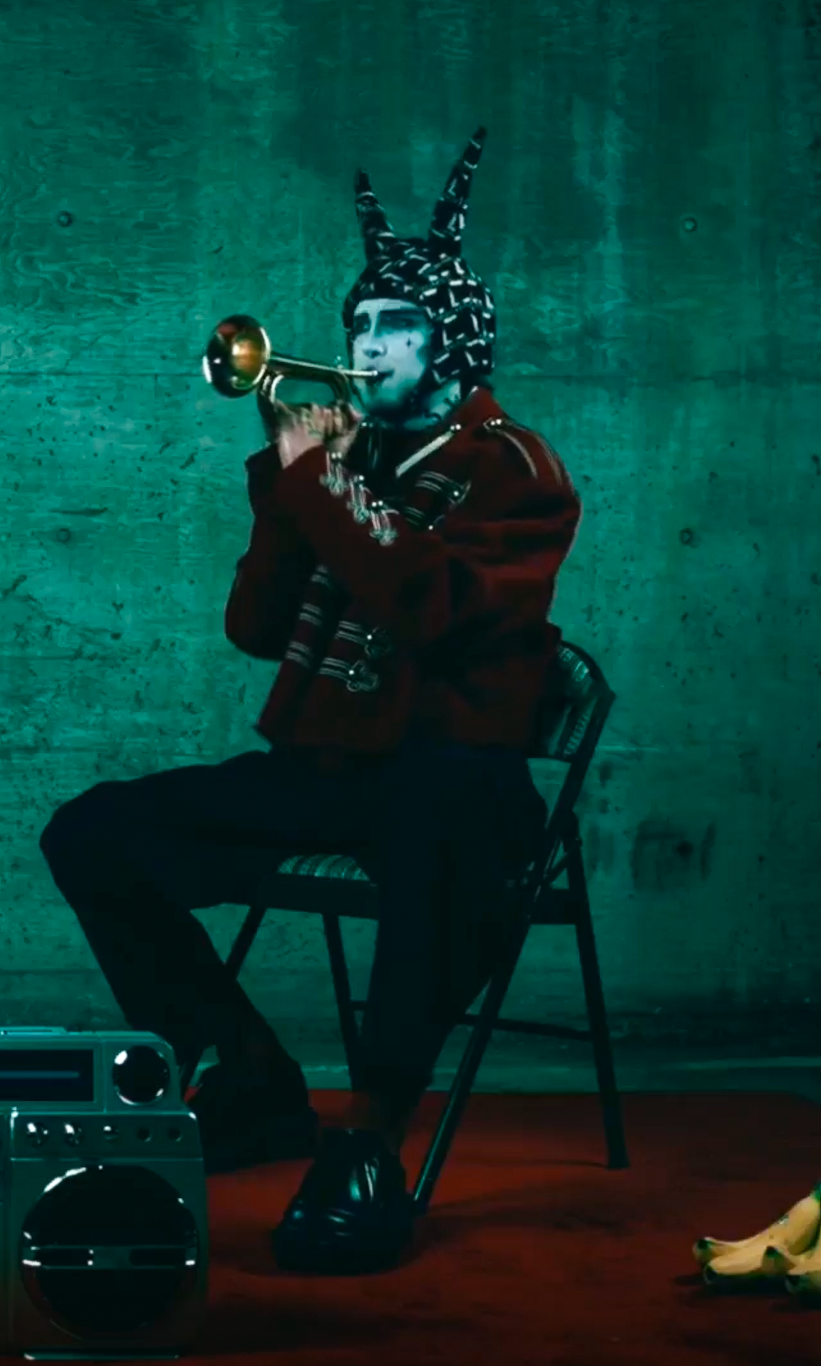
> *A solo fanfare to a boombox, bananas on the floor.*
>
> A herald is supposed to announce someone greater. Lucius announces himself. He has the instrument of arrival but no king behind him, or worse, he has mistaken himself for the king. The horn makes his morning-star tragedy physical: the herald mistaken for the source, the bright one who announces a dawn he is then outshone by.
>
> The sharpest turn is an inversion, which is his signature. The catalogue already has a *true* trumpet, Jericho's, where the wall of separation falls to *"trumpets and the people's shout"* (Joshua 6), read as [[The Loop and the Circle (Reading Path)|the Circle]] years early, the shared voice that heals. Lucius takes the same instrument and plays a *solo* to a machine. Same horn, opposite function: the communion-fanfare becomes the one-man announcement of himself. And a horn is *hollow,* a tube of air that makes an impressive noise and holds nothing, which rhymes with the sterile banana beside it and the husk that usurps the source.
>
> It is *welcome in versus welcome out* rendered in brass. In [[Welcome to the Circus]] the invitation pulls you *into* the tent. In the premiere speech the energy flips, *"get out of the way, the future is arriving, you're welcome,"* conquest dressed as etiquette. Same word, opposite direction. He can expose the circus and become the ringmaster, say the machine is ending while using the machine to broadcast it.
>
> There is an acoustic tell, too. When the true song lands, the crowd sings it back and something crosses: a transmission completing. **When Lucius sings, the crowd sings back to him, but it's distorted, babel, a closed tower, a vessel that can't transmit.** Same call, same response, nothing carried home.
> [!cast]- Homies
> - **[[Roy]]** — the center of everything. Roy is not the *opposite* of Lucius; **Roy is what Lucius was built to protect.** The tension is mind serving heart versus mind replacing heart, *"I made you."* And the border between them is not a cliff but a slope: Roy does not fall into Lucius, he slides toward him, because Lucius is not a different person, he is a different frequency of the same one. They read cleanly as [[Jacob and Esau]]: one origin split in the womb, one blessing divided, ending not in conquest but embrace.
> - **[[Mary]]** — the anti-Lucius. Where Lucius reflects (a mirror), Mary transmits (a window). She is the one frequency he cannot absorb. Kept distinct from the Wise One and SARAVI, archetypal neighbors, not one identity. See the Mary drawer above.
> - **[[Sir Rabbit]]** — the seeker-pole *before* the split, not a proto-Lucius. In the dream, Roy is the rabbit seeking; Lucius is the second rabbit who intercepts.
> - **[[The Attention Economy and the Circus|Leif]]** — Lucius's enforcer-bodyguard, the one who calls *Lucius* *"Boss."* The foil who lets Lucius cohere: without an audience to play off, he does not hold together.
> - **[[The Attention Economy and the Circus|BMRC]]** — the Black Magic Rainbow Circus, glimpsed as a corporate signature on the props (*"PROPERTY OF B.M.R.C."*). Read it as Lucius's *own* company logo, not a master above him. Lucius crowns himself the final boss and answers to no one he will admit; the true higher power is the *champion* he denies, [[Mary]] or [[Roy]]. It stages the open question: is the disruptor pose opposition, or unwitting assignment to the pattern he thinks he escaped?
> - **[Michael Morgan](https://www.instagram.com/themichaelmorgan/)** — a real Jagwar Twin producer and video collaborator (the *MM* in the credits), whom Lucius folds into the fiction by sneering at *"his social media manager, Michael MM."* A real person pulled onstage, not a new character.
> - **[[The Jaguar]]** — the larger seeing-field. Lucius reads as a distortion *within* that seeing, not its equal.
> [!reading]- Strong Guesses
> Not confirmed intent. Strong reads built from the public material and the symbol logic above.
>
> 1. **The Dweller on the Threshold.** The load-bearing frame for Lucius: he reads as Roy's Dweller, self-generated (*"I made you"*), mirror-anchored, growing in proportion to whatever has been disowned, and undefeatable by force. The Dweller does not begin, it accumulates, and 2026 is not Lucius arriving, it is Lucius being *seen.* (This is a strong reading, not deep speculation; the lineage lives in the Inside-of-the-Inside.)
> 2. **A protector who needs the wound to stay open.** A protector formed around trauma will crave healing and sabotage it in the same breath, because healing dissolves its job. If Roy becomes whole, Lucius no longer rules. Across the lore he behaves less like a sovereign than a child performing sovereignty, checking the camera to see if he is being watched. **What is ambiguous: does he truly want the best for Roy? Probably? Maybe? We know that the ancestral shadow portion of him has a stake in keeping the dance going forever.**
> 3. **A reflection reaching for usurpation.** Not a smudged copy, a rival claimant: the reflection trying to become the source itself. The mirror that wakes becomes the reflection that sells.
> 4. **He tells true things from the wrong center.** His danger is not falsehood, it is heartless accuracy. A true sentence can still be used to kill. He is the master of that.
> 5. **The clown is the mechanism, not decoration.** Clowning turns humiliation into control and lets Lucius be seen without being known. The clown is not hiding the villain. The clown is hiding the child.
> 6. **The apple is premature knowing, not temptation in general.** He tempts with strategy, certainty, and the feeling of finally knowing how the game works, mistaking cleverness for wisdom because cleverness gets results faster.
> 7. **The trumpet is the false herald made visible.** The instrument of announcement, curved back toward himself. The Light-Bearer tragedy in miniature: the one who should announce the light becomes obsessed with being seen *as* the light.
> 8. **He is the closed relational mirror.** The mirror is not only a surface, it is a relationship, and Lucius closes the relation: he reflects the self into performance, the wound into identity, the audience into command. The healthier mirror lets the soul become visible through the heart. He lets the wound become visible through the mask. Not the same thing.
> 9. **A Gurdjieffian self-diagnosis turned into public art.** The figure amounts to the artist saying: *I am the false personality I am warning you about, watch me try to see it.* Masks and split selves are defense mechanisms, and Lucius is the defense mechanism given a name and a costume, the master of the many I's.
> 10. **The charismatic transmitter.** Structurally, **Lucius is a model of the charismatic spiritual figure who transmits real material while distorting it through self-interest,** and he is hard to unmask precisely because the people selling spirituality use the same language as the people living it. The distorted reflection, the encounter that looks like seeing and is not.
> 11. **The meta-collapse.** Roy in his own voice conceded *"I guess Lucius was right again"* as *Welcome to the Circus* broke out, and for a second the biographical and theatrical layers fuse. Which sharpens the whole open question: protecting Roy, or training him to rule the circus?
> [!map]- Hey! You Look Familiar!
> A lens, not a claim of authorial intent. The page works without it. If this part starts driving the car, it has been overcooked. None of it is the answer, it's one way of seeing it.
>
> **Hod / Mercury.** In the fundamentals map Roy points to, Lucius sits at Hod, Mercury: intellect, speech, cleverness, analysis, naming, framing, argument, speed, the mind's power to separate and manipulate symbols. That does not make Hod bad. The point is mind *severed* from heart. Lucius is Mercury without mercy.
>
> **Netzach / Venus** is [[Roy]]'s counter-pole: heart, beauty, desire, art, devotion. So the better pairing is not "Mercury versus Venus" as enemies, it is Mercury *serving* Venus, mind serving heart. Lucius is what happens when the servant takes the throne. (Venus and the moon both belong to Roy; Lucius has neither, which is exactly why the morning-star name below stays a footnote.)
>
> **The horizontal polarity (the important brake).** There is a real danger in making this too clean: Lucius bad, Roy heals, Lucius disappears, roll credits. That may not be the structure. If Hod and Netzach form a *necessary* polarity, then Lucius is not merely a prison to escape, he is a function that has to be restored to right relationship. The problem is not that Lucius exists. The problem is that Lucius *rules.* So the aim may not be his destruction. It may be right relation: mind serving heart, heart carrying sword, mirror becoming relational.
>
> **Yesod** is his operating theater, not his identity: the reflective image-realm of mirrors, screens, masks, and audience feedback, the glamour he works *through.* Which is why his broken imagery (the sterile banana, the artificial apple) reads as Yesod gone wrong. But do not mistake the theater for the seat, the moon of Yesod is Roy's, not his.
>
> **Lucifer / morning star** stays a footnote, never a headline. *"Lucius equals Lucifer"* is too flat. The better version: he carries a *morning-star problem.* He may announce the dawn, but he is not the sun. When the herald forgets that distinction, the fall begins. (This is a name-resonance in the light-bearer field, held loosely, never his seat; see [[The Light-Bearer]] and [[Machine vs Human]].)
>
> **El Roi, held at resonance, not method.** The throat marking is grounded as **Sir Lucius's character marking**, part of the mask, and not as ink on Roy's own body. The deeper letter-work (the seeing / mirror field around the same Hebrew root) belongs to a letter-mysticism tradition, not to anything Roy has stated as his method, so it is kept as resonance and carried in the private analysis rather than derived here. The useful point stands without the mechanism: Lucius may have the right structural letters and the wrong relational use of them. He turns seeing into performance and the mirror into a closed loop, and wears the seeing-name at a throat that speaks from a center cut off from the heart. Roy's *El Roy* points toward the same skeleton breathed differently. (See [[El Roi]] and [[The Relational Mirror]].)
>
> **The named sources.** The framework is not imposed from outside; these authors sit on Roy's public shelf. Dion Fortune (*The Mystical Qabalah*) gives the shadow thesis nearly verbatim: *"The shadow is not evil. It is power unrecognized and therefore misused."* Gurdjieff, his most-named influence, supplies the "many I's" behind the three modes. Jung's Trickster (a forerunner of the savior, *"both subhuman and superhuman,"* whose chief trait is his unconsciousness) is one Roy has actually posted, which grounds the herald read as more than resonance. And C. S. Lewis's Screwtape supplies the mechanism: counsel-as-temptation.
> [!warning]- How this reading could be wrong
> The page needs brakes, and honestly it should keep them in reach.
> - If the plain reading (mind severed from heart) explains the figure well enough, the whole sefirotic superstructure is decorative. Interesting, not necessary. Keep asking whether it *adds* explanatory power or just decorates a complete doctrine.
> - The three-register synthesis (manipulation / shadow / protective love) is load-bearing *and* nearly unfalsifiable, because any behavior seems to confirm it. To keep it a claim and not a mood, name what would count against it: a genuinely cruel act with *no* vulnerable thing being guarded would pressure the "protective love" register.
> - There is **no Boss above Lucius,** and the page must not build one. Leif calls Lucius "Boss"; Lucius crowns himself "final boss." Read as a hierarchy he reports to, the whole Boss/BMRC cosmology is wrong, not merely over-read.
> - The *El Roi* letter-mysticism rests on a method Roy hasn't stated (consonants-as-angles, vowels-as-breath is explicitly *not* his declared system), so keep that synthesis as the analyst's resonance, not his.
> - The dagger/sword tension (🗡🍏 while Roy holds the sword) should stay flagged, not smoothed. Best held as Lucius impersonating by wearing his twin's emblems.
> - If every prop becomes a code, we have lost the plot. Sometimes a cigarette is a cigarette. The trick is noticing when the joke keeps pointing at the same wound.
> - And keep the tidy version on the table: Lucius as the *monster of the week,* defeated at last, duality resolved, roll credits. Clean, dramatic, simple. This page bets it is also wrong, but the bet should stay visible.
> [!question]- Open questions
> - Is Lucius protecting Roy, or training him to rule the circus?
> - Is his rebellion his own, or an unwitting assignment to the very pattern he thinks he inverted, the Circle turned Circus?
> - Can the protector become a guide, or does he have to be outgrown?
> - Is Lucius a temporary prison, or a permanent mind-pole that has seized the throne and must be *right-related* rather than destroyed?
> - Why can he handle truth, spectacle, fear, numbers, and mockery, but not *SOL*?
> - What exactly is BMRC / the "Boss": algorithm, capital, system, or theatrical joke?
> - The dagger-and-apple signature while Roy holds the sword, deliberate impersonation, or just an emoji? Held open.
> - Does the *Lucius Lullaby* arc actually resolve (loop to circle, mind re-subordinated to heart), or end with Lucius still the final boss?
> [!receipts]- What is grounded, read, and framework
> **Grounded** (direct quotes, released music, public posts and videos): the definition *"the mind divorced from the heart"* and *"a tool… if it is not subservient to the heart"*; *"I made you"*; *"the truth is a spectrum but a lie is a lie"*; the *El Roi* throat marking; the green apple and the LOOP teaser decode; the Devil-card / Paul Foster Case pointer; the 2024 Instagram takeover (*"the truth can be deceiving 🍏"*) and one-hit-wonder rant signed 🗡🍏; the co-credit and premiere takeover; *Good Time (1:08)* iconography and *"mastermind"*; the *Rorrim Ehtni* 2008 credit; the dream origin and *"i just have to let him come through"*; the trumpet and bandsman regalia; *Welcome to the Circus,* *Not Your Homie,* *Weirdness,* *#1 Champion* (Mary's *"gun in her hand"* against Lucius's performed force); the *STOP SIR LUCIUS* campaign and the *Interview* episodes (the bargain, the banana, *"the algorithm baby,"* the kidnapping, the moth speech); the named influences (Screwtape, Dion Fortune, Gurdjieff, the posted Jung Trickster card).
> **Strong readings** (interpretive, built on the grounded material): the Dweller on the Threshold; protector turned jailer; reflection reaching for usurpation; truth from the wrong center; the three modes; twin-versus-clone; the false herald and the Jericho inversion; the closed relational mirror; Mary's creative authority versus his theatrical force; *seen before named*; the *"I guess Lucius was right again"* meta-collapse.
> **Framework** (esoteric, syncretic, never authorial intent): Hod / Mercury; Netzach / Venus; the Hod / Netzach polarity as possibly permanent; Yesod as operating theater; Lucifer / morning-star as footnote; the *El Roi* letter-work as resonance, not method or proof.
> **Discipline.** Start with the visible material, then the songs, then public statements, then strong readings, then framework. Do not let the rabbit hole walk the dog.
---
## Read next
- [[Roy]] — the heart Lucius was built to protect, and replaced.
- [[Mary]] — the frequency he cannot absorb.
- [[The Green Apple]] — his mark, decoded.
- [[The Relational Mirror]] — soul, heart, mirror, witness, and recursion.
- [[Welcome to the Circus]] — Lucius at full external power.
- [[Lucius Lullaby (album)|Lucius Lullaby]] — the album that hands him the mic.
- [[The Interview]] — the bargain staged as comedy.
- [[The Light-Bearer]] — the false herald and morning-star resonance.
- [[City of Angels]] — Twin versus Clone in the fame-gospel.
> [!door]- The Inside of the Inside, deeper speculation
> Past this point the floor gets slippery. This is where the deepest Lucius material lives: the earliest Eye Alaska traces, the 2021 shadow-voice, the Dweller-on-the-Threshold lineage in full, and the name research (Lucifer / lux / Luke-via-Steiner), the parts that rhyme too hard to ignore but are not grounded enough to treat as fact. Interesting, clearly labeled, never authoritative.
>
> **[[Sir Lucius — The Inside of the Inside|Step inside the inside →]]**